
Bus Fever - Car Parking Jam
Microjoy GamesPuzzle
4.6433.00 Reviews
- Version
- 1.19.4
- Installs
- 1.00M
- Age Rating
- Everyone
Screenshots
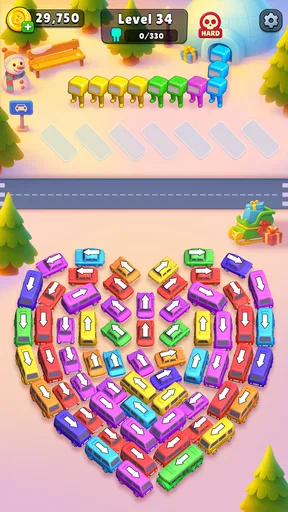
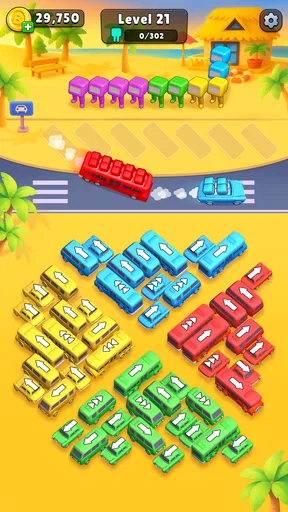
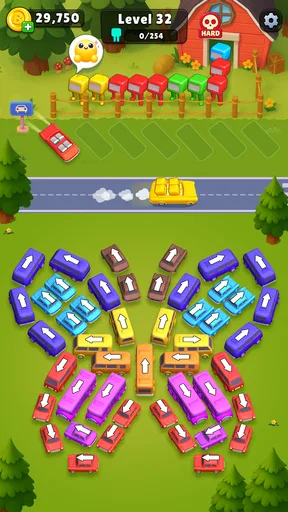
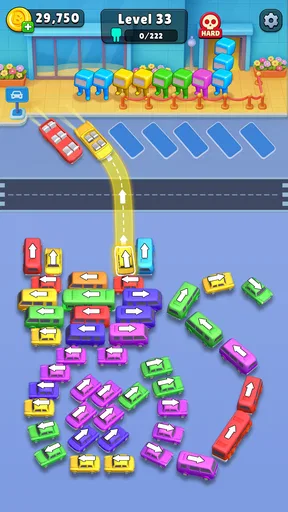
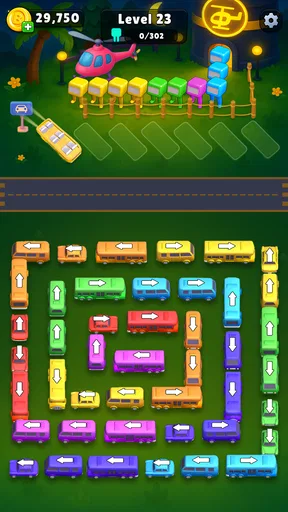
Our Review of Bus Fever - Car Parking Jam
 Analysis by Appyee
Bus Fever - Car Parking Jam is the kind of puzzle game I can open for a short break and understand almost immediately. The screen presents a crowded traffic situation, and my job is to work out how to move vehicles in the right order so passengers and buses can progress without turning the road into a worse mess. That simple premise gives each level a clear visual problem: find the useful first move, avoid blocking the useful second move, and keep adjusting when the obvious route is not the correct one.
Developed by Microjoy Games, this free puzzle game sits in a familiar mobile space, but its bus-and-traffic setting gives the usual parking-jam formula a more readable identity. It is aimed at Everyone, works on Android 6.0 or later, and has reached over a million installs. The current version is 1.19.4, while its average score is 4.6 from roughly thirty-nine thousand ratings. Those figures suggest that the straightforward idea has found a sizeable audience, although popularity alone does not make every level equally satisfying.
My first impression: clear goals, quick decisions
My first useful discovery was that the game does not need a long explanation to become understandable. The traffic arrangement communicates most of the rules visually. Vehicles occupy limited space, exits and destinations matter, and a careless move can remove the room needed for the next one. That makes the opening experience approachable even if you are not normally a puzzle player.
The best part of this presentation is the immediate feedback. I can test a move, see whether it opens a lane or creates another obstruction, and then rethink the position. The challenge is not based on memorizing a complicated interface. It comes from reading the board accurately and resisting the urge to move the first vehicle that appears available.
That accessibility also reveals the game's main limitation. The basic idea is easy to grasp, so the long-term interest depends heavily on how well the stages vary the traffic patterns. When a board introduces a genuinely different order of operations, I feel rewarded for planning. When it mainly asks me to repeat the same clearing routine with a slightly busier arrangement, the experience becomes more mechanical than thoughtful.
I would recommend starting with a calm mindset rather than treating every stage as a race. The game works better when I pause for a moment and scan the entire layout before tapping. Looking at the vehicles that are already near an exit, then tracing which pieces block them, is often more useful than focusing on the most visually prominent bus. This small habit turns random tapping into a repeatable solving method.
A setting that makes the puzzle easy to read
The traffic theme is more than decoration because it gives the board a natural vocabulary. Cars, buses, lanes, and congestion make the idea of “free this route first” intuitive. I do not need abstract symbols to understand why a vehicle cannot pass. The setting supplies a reason for the puzzle's restrictions, which helps the game feel coherent even when the underlying task is a familiar sliding-and-order problem.
The visual style also supports quick sessions. I can glance at the screen and identify the major objects without studying a dense interface. That matters on a phone, especially when playing while waiting for an appointment or taking a short break. The board remains the focus rather than surrounding menus or decorative distractions.
At the same time, the cheerful traffic presentation can soften the frustration of a failed attempt. A blocked lane feels like a puzzle mistake rather than a serious penalty. I appreciate that tone because it encourages experimentation. I can try a different sequence without feeling that I have lost a large investment of time.
The trade-off is that a bright, friendly setting may not satisfy players looking for a strong narrative world. There is no reason to choose this game if you want character development, exploration, or a story-driven journey. Its world is a playable language for arranging traffic, not a place I become emotionally attached to. That is perfectly appropriate for a compact puzzle, but it defines the audience clearly.
How art direction shapes the solving process
The art direction works best when it separates the important information: which vehicle can move, which path is blocked, and where the traffic needs to go. In a puzzle like this, attractive visuals are useful only when they preserve that clarity. I found myself judging the board by silhouettes, positions, and open space rather than by decorative details, which is exactly what a traffic puzzle should encourage.
One practical tip is to treat empty road as a resource. It is tempting to think only about the vehicles, but the available space determines whether a move is safe. Before moving a bus, I check whether that action leaves enough room for another vehicle to turn or leave. This is a non-obvious shift in perspective: the goal is not simply to move something forward, but to preserve the next useful space.
Another helpful approach is to identify “temporary” moves. Sometimes a vehicle must move away from its apparent destination so that a more important route can open. I initially found those moves counterintuitive because they look inefficient. Once I began viewing them as space-making actions rather than progress, the layouts became easier to analyze.
Sound, rhythm, and the feel of a short session
The game's mood depends on more than the traffic arrangement. Its visual setting suggests a light, active environment, while the puzzle structure creates a stop-and-go rhythm: inspect, tap, watch the result, and reassess. That rhythm suits mobile play because each decision has a visible consequence and the session can naturally pause between stages.
I like this pacing when I have only a few minutes. It does not demand the uninterrupted attention of a long strategy match, yet it still gives me a small problem to solve. The traffic theme reinforces that tempo. The board feels busy, but the actual interaction remains focused on a sequence of manageable decisions.
The limitation is that this rhythm can become repetitive if I play for too long without a change in challenge. A puzzle based on the same central action needs meaningful variation to maintain momentum. For me, the game is strongest in short bursts, where the compact decisions feel refreshing. Extended sessions are more dependent on whether the current layouts are offering new reasoning rather than merely more obstacles.
I also see the sound and pacing as part of the game's accessibility. A player who prefers quiet concentration can focus on the board without needing to follow a complex story or react to rapid action. Conversely, anyone seeking energetic arcade intensity may find the deliberate traffic-solving tempo too gentle. The game asks for patience, not reflexes.
Where the mechanics fit—and where they do not
At its core, this is a sequencing puzzle. The important question is rarely “Can I move this vehicle?” but “Should I move it now?” That distinction gives the game more depth than its simple controls suggest. A legal move can still be a bad move if it occupies the only useful space or blocks the route needed by another vehicle.
My most reliable workflow is to divide the board into three groups: vehicles that can leave immediately, vehicles that are blocking those vehicles, and vehicles that should remain untouched until later. I then look for the smallest move that opens a route without consuming valuable space. This method is especially useful on crowded layouts because it prevents me from making several speculative taps in a row.
It is also worth separating a failed plan from a failed level. If a sequence collapses, I do not assume the entire board is too difficult. I go back to the first decision that reduced my options and change that one step. This makes retries more informative and keeps the puzzle from feeling like trial and error.
The game is a good fit for players who enjoy visual logic, ordering problems, and gradual improvement. It is less suitable for someone who wants deep resource management, competitive multiplayer, or a large set of unrelated puzzle types. Compared with a traditional match-three game, it offers less emphasis on quick combinations and more on deliberate planning. Compared with a classic sliding-block puzzle, it adds a friendlier traffic context and a more immediately understandable objective.
That comparison also highlights a trade-off. Traditional abstract puzzles can be more intellectually pure because every piece is just part of a formal system. Bus Fever is more approachable because the road setting explains the system at a glance, but some experienced puzzle fans may find the theme less demanding than a highly abstract logic challenge. I would choose it for accessibility and short sessions, not for the deepest possible puzzle complexity.
Free to start, with a point to consider
The game is free to download, which makes it easy to try without committing money first. It includes in-app purchases ranging from ninety-nine cents to ninety-nine dollars and ninety-nine cents per item. That range is important for anyone deciding how to use it: the core download is accessible, but the presence of purchases means I would still check the purchase flow carefully before handing the phone to a child.
Because the age rating is Everyone, the presentation is suitable for a broad audience. Parents looking for a simple logic game may find the traffic theme approachable, and the lack of complex controls makes it easy for a younger player to understand the basic objective. I would nevertheless treat the purchase settings as a separate practical concern, especially on a shared device.
For my own use, the free entry point is the strongest reason to test it. I can quickly determine whether the level design suits me before considering anything optional. If I am looking for a completely purchase-free experience or a puzzle with no commercial interruptions at all, I would compare it with a paid premium alternative instead. That choice usually costs more at the beginning but can feel cleaner for long-term play.
Who will enjoy it in everyday use
A realistic use case is a short wait at a bus stop, in a clinic reception area, or between two errands. I can open a stage, inspect the traffic, solve a few moves, and put the phone away without needing to remember a complicated story. The bus theme even fits the setting naturally, although the game remains useful anywhere I want a contained mental distraction.
It is also a good option for someone who likes to improve through observation rather than speed. I can replay a layout mentally, notice why a route failed, and develop a better order. That makes it more satisfying than a purely idle activity, while still being less demanding than a full strategy game.
Players who should skip it are those who become irritated by repeating similar board logic, need constant novelty, or prefer action that rewards fast reactions. The traffic setting will not compensate for that mismatch. Likewise, if you want a story-rich bus simulation, this is not the right choice: the buses are part of the puzzle language, not a management system.
My atmosphere verdict
What holds the experience together is the agreement between its theme and its mechanics. Congested roads naturally suggest order, patience, and careful use of space. The art direction makes the puzzle readable, the sound-and-action rhythm supports short sessions, and the pacing gives each decision room to matter. I never feel that the traffic setting is completely unrelated to what I am doing.
Its weaknesses are equally clear. The central idea can lose freshness during a long session, and players seeking substantial narrative or advanced strategic systems will find the scope limited. The free model also deserves a little attention from families and anyone who prefers a purchase-free environment. Those are not reasons to dismiss it, but they are reasons to choose it for the right situation.
Overall, I see Bus Fever - Car Parking Jam as a polished, approachable choice for visual puzzle fans who want short, readable challenges with a consistent traffic mood. Microjoy Games has built the experience around a simple question—what should move first?—and the best stages make that question surprisingly engaging. I would install it for casual problem-solving, use the empty-road method to avoid careless blocks, and play in short bursts. If that combination of buses, congestion, and deliberate planning sounds appealing, this free Everyone-rated game is worth trying on a compatible Android device.
Verdict
Strengths of Bus Fever - Car Parking Jam
- Simple controls make the parking and traffic puzzles easy to pick up.
- Short levels are convenient for quick gaming sessions.
- Colorful visuals give the game a cheerful, accessible presentation.
- Increasing traffic challenges keep later stages more engaging.
- Offline play makes it useful when you have no internet connection.
Limitations of Bus Fever - Car Parking Jam
- Repeated parking layouts can make the gameplay feel predictable over time.
- Some levels depend heavily on finding the correct move order.
- Ads may interrupt play, especially between completed stages.
- Progress can feel slow if upgrades or new areas require repeated levels.
- The game offers limited depth for players seeking complex strategy mechanics.
Similar Picks in This Category
View All
Block Blast!
HungryStudio4.8

Braindom: Brain Games Test
Lahana Game Studio4.6

AMAZE!
CrazyLabs LTD4.6

Sudoku - Classic Sudoku Puzzle
Oakever Games4.7

Art Puzzle - Puzzle Games
Easybrain4.8

Amaze GO!
Oakever Games4.9
Frequently Asked Questions
What is Bus Fever - Car Parking Jam?
Bus Fever - Car Parking Jam is a casual puzzle game focused on organizing crowded parking areas and helping vehicles, including buses and cars, leave without getting blocked. You must study the position of each vehicle, choose the correct movement order, and clear the traffic efficiently. Later levels generally introduce tighter spaces, more vehicles, and trickier layouts that require patience and planning.
How do you play Bus Fever - Car Parking Jam?
The basic gameplay is easy to understand, but completing advanced stages requires careful thinking. Tap or select vehicles to move them when their path is clear, then create enough space for the remaining cars and buses. A careless move can block another vehicle, so it is better to observe the entire parking area before acting. The main objective is to solve each jam with as few mistakes as possible.
Is Bus Fever - Car Parking Jam free to download and play?
Bus Fever - Car Parking Jam is generally offered as a free-to-download game, allowing players to begin solving parking puzzles without an upfront purchase. However, free mobile games may include advertising, optional in-app purchases, extra lives, hints, or other convenience features. Before downloading, check the current store listing for the exact pricing, available purchases, and whether some content or assistance requires payment.
Does Bus Fever - Car Parking Jam require an internet connection?
The core parking puzzles may be playable without a permanent internet connection, which makes the game suitable for short sessions while traveling or when mobile data is unavailable. Nevertheless, certain features can depend on connectivity, including advertisements, rewards, cloud synchronization, events, updates, or purchases. Availability may also vary between versions, so test offline play after installation rather than assuming every feature works without internet access.
Is Bus Fever - Car Parking Jam suitable for children and casual players?
The game is designed around simple controls and visual parking puzzles, making it approachable for casual players and younger users who enjoy problem-solving. Even so, later stages can become challenging and may encourage repeated attempts or the use of hints. Parents should review the age rating, advertising, and in-app purchase settings on the relevant app store, especially if children will play on a shared device.
Play our best games!


